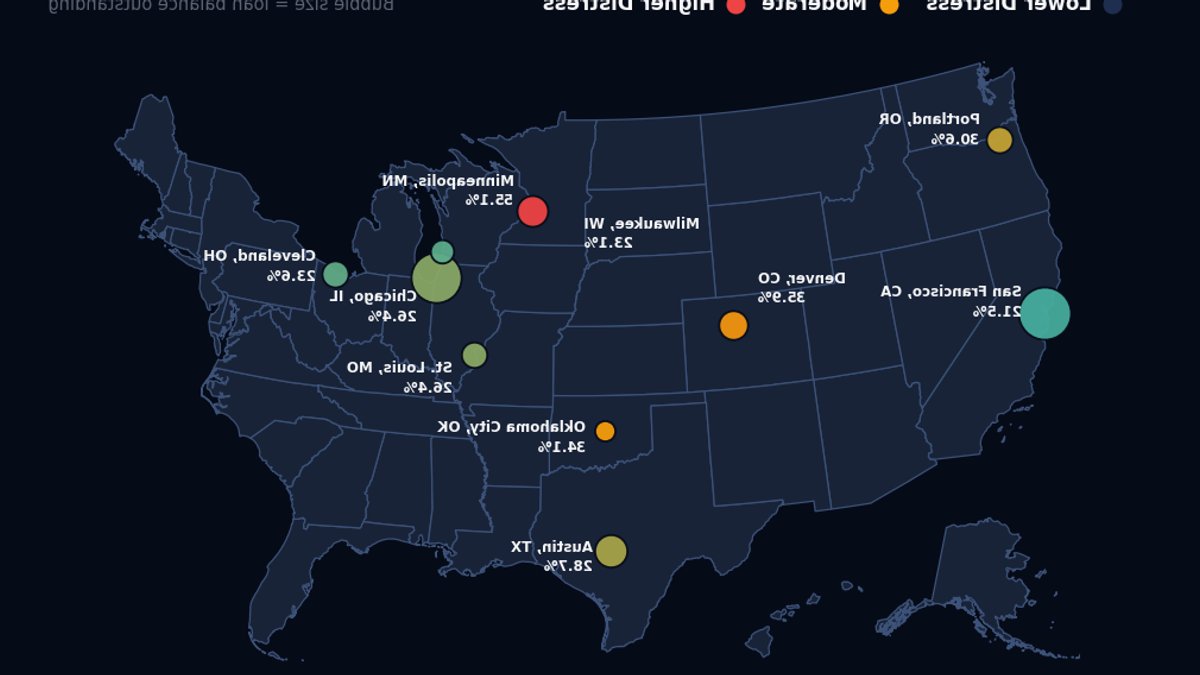
CMBS distress has risen to $45.8 billion across the 50 largest U.S. markets, representing an 11.6 percent balance‑weighted rate, according to recent CRED iQ data.
Metro areas with the highest distress rates
Minneapolis tops the list with 55.1 percent of its CMBS balance classified as distressed, followed by Denver at 35.9 percent and Oklahoma City at 34.1 percent. Those three metros are each dominated by a few very large loans rather than a broad‑based decline. Portland, Oregon, sits at 30.6 percent, Austin at 28.7 percent, and a Midwestern cluster—including Chicago (26.4 percent), Cleveland (23.6 percent) and Milwaukee (23.1 percent)—rounds out the top tier. San Francisco records 21.5 percent distress.
At the opposite end, Phoenix, Boston, Las Vegas and Orlando hover around 3 percent, while San Diego shows 0.4 percent and Salt Lake City reports no distressed balance at all.
Shifts in property‑type performance
Office loans remain the largest source of cumulative distress, accounting for 16.7 percent of the total or roughly $22.5 billion. Mixed‑use assets follow at 14.4 percent, then multifamily loans at 13 percent, lodging at 10.6 percent, and retail at 8.8 percent. Industrial loans stand out as the only category with distress below 2 percent.
Since February, multifamily distress has more than doubled, climbing from 6 percent to 13 percent, while office distress fell from 21.2 percent to 16.7 percent. This reversal reflects changing cash‑flow patterns as rental demand steadies and some office tenants renegotiate leases.
Regionally, the Midwest’s ten largest metros average 22.7 percent distress, driven by concentrations in Minneapolis, Chicago, St. Louis, Cleveland, Milwaukee and Cincinnati. The Northeast, West and South each sit near a 10 percent rate.
July’s new distressed loans
In July, 180 loans totaling $992 million entered distress. Multifamily loans made up about 96 percent of that amount, highlighted by an $84 million apartment loan at Weston Medical Center in Houston that became 60‑plus days delinquent.
Related: New York Gets Another Economic Boost
The largest single event involved a $111 million special‑servicing transfer of two hotel loans in Santa Monica, California. Other notable additions include a $61 million loan for Ariza Forest View apartments in Santa Rosa Beach, Florida, and a $53.1 million loan for Mirasol apartments in Las Vegas that fell delinquent at performing maturity.
Additional July entries feature a $49.6 million loan for Solaire apartments in Bethesda, Maryland, a $38.9 million loan for The Sophia apartments in Dallas, and a $19 million loan for the Bank of America Tower in Midland, Texas, which is part of a five‑property, $43 million distressed office portfolio.
Risk remains high.
The data suggest that while office distress has receded, the surge in these assets could keep overall CMBS risk raised for the foreseeable future. If lenders continue to tighten underwriting standards on residential projects, the sector may see a gradual return to lower distress levels, but the concentration of large loans in a few metros means any further defaults could still shift the balance quickly.
Analysts note that the Midwest’s high distress figures are largely a statistical artifact of a few oversized loans rather than a systemic weakness across the region. This nuance matters for investors who might otherwise discount the entire area based on headline numbers alone.
Liam Mulcahy, senior product manager for CRE data and applied AI at CRED iQ, provided the figures used in this report.


